Baseline Nutrition
The Starting Point — Not the Full Prescription
Every giant breed dog runs on the same core biological requirements. Water, protein, fat, minerals, and energy form the foundation that supports their joints, organs, digestion, and daily function. These baseline needs exist regardless of breed, role, or lifestyle. They are the nutritional equivalent of oxygen—without them, nothing else works properly.
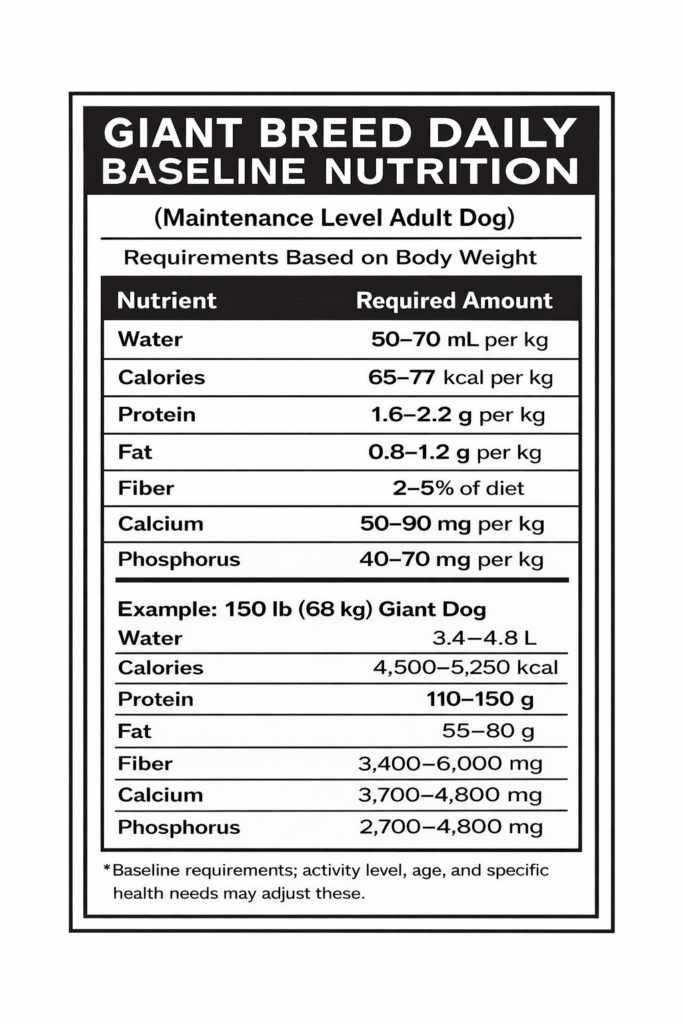
The chart below represents maintenance-level nutrition for a healthy adult giant dog. This is not a performance diet, a growth plan, or a senior adjustment. It’s the physiological baseline—the point where the body can maintain itself without gaining, losing, or compensating. Think of it as the reference point that allows you to evaluate whether your dog’s current feeding routine is fundamentally supportive or slowly working against them.
What matters most is understanding that this baseline is only the beginning. A sedentary senior, an active working dog, and a growing adolescent may all start here—but their real needs will shift above or below these numbers. Activity level, age, metabolism, and digestive tolerance all change how nutrition must be balanced. The Feeding System exists to help you make those adjustments with intention, so you’re not just feeding your dog—you’re supporting the life they actually live.
Use this baseline to understand the fundamentals. Then move deeper into your dog’s specific profile to build a feeding approach that truly fits them.
This is the physiological baseline your giant dog’s body is built around. Everything else in the Feeding System adjusts from here.
How to Use the Feeding System
Now that you know the baseline your giant dog’s body depends on, the next step is simple: adjust it to match the life your dog actually lives.
The Feeding System works by helping you match two real-world factors:
• Your dog’s life stage (Puppy, Adult, Senior)
• Your dog’s activity role (Companion, Active, Working)
These two variables determine how your dog uses energy, builds muscle, maintains joints, and processes nutrients.
A young, active Great Dane supporting daily training places very different demands on their body than a senior Mastiff who enjoys quiet walks and long naps. Both are healthy—but their feeding profiles should not look the same.
Once you select your dog’s profile, the Feeding System shows you:
• How their calorie needs shift
• How protein and fat requirements adjust
• What digestive support becomes more important
• What feeding habits improve long-term comfort and stability
This allows you to evaluate any food—not based on marketing—but based on whether it actually supports your dog’s body.
Because the goal isn’t to tell you what brand to buy.
The goal is to help you recognize what your dog needs—and choose accordingly.
How to Read Dog Food Labels
What actually matters when choosing food for a giant breed dog
Most people choose dog food the same way. They look at the price, check that the bag says it’s made for giant breeds, and make sure it matches their dog’s age. Those things are helpful, but they only tell you who the food is marketed to—not whether it truly supports your dog’s body. The real story lives on the nutrition label, and learning to read it changes the way you evaluate every option in front of you.
The first number worth your attention is protein. Protein is what maintains muscle, supports joint stability, and keeps the immune system functioning properly. For most adult giant breed dogs, a moderate, steady level is ideal—typically somewhere in the range of 18 to 24 percent. Below that, muscle maintenance can suffer over time. Far above that isn’t automatically better either, unless your dog is living a highly active or working lifestyle. What matters most is consistency and balance, not extremes.
Fat is the next piece of the picture. Fat provides energy and supports skin, coat, and cellular health, but in giant breeds it needs to remain controlled. Too little fat can leave a dog feeling depleted, while too much quietly adds weight that places unnecessary stress on joints and connective tissue. For most adult giants, moderate fat levels help sustain energy without creating long-term strain.
Calcium is one of the most overlooked nutrients, and one of the most important. Giant breeds process calcium differently than smaller dogs, and excessive levels over time have been closely linked to skeletal stress and joint problems. This doesn’t mean calcium should be avoided—it means it should be balanced. Stability and proportion matter far more than simply having more.
Beyond individual numbers, consistency itself plays a major role in digestive health. Giant breed dogs tend to do best when their nutrition remains stable and predictable. Frequent food changes, extreme formulas, or constantly switching based on trends can disrupt digestion and create problems that aren’t immediately obvious. A balanced, consistent approach allows the digestive system to function the way it was designed to.
Many long-term feeding problems don’t come from dramatic mistakes, but from small decisions repeated over time. Choosing food based only on price, for example, can sometimes mean accepting lower nutritional balance without realizing it. The bag may say “giant breed,” but that label alone doesn’t guarantee the internal nutrition matches your individual dog’s needs. Activity level matters just as much as size, and feeding a low-activity dog like a high-performance athlete—or the reverse—slowly creates imbalance. Even overfeeding, which often comes from good intentions, places continuous strain on joints, ligaments, and overall structural health.
The purpose of the Feeding System is to give you a way to see past marketing and understand what your dog’s body is actually asking for. It isn’t about forcing you into a specific brand or telling you there is only one correct choice. It’s about giving you a reference point—a way to recognize balance, avoid common mismatches, and make feeding decisions with confidence. When you understand the system behind the label, you stop guessing. And over time, those small, informed decisions become one of the most important investments you can make in your dog’s long-term health.
How Activity Level Is Defined in the Feeding System
Activity level in the Feeding System is not based on energy, excitement, or how much your dog runs around the yard. It is based on structured physical demand, duration, and recovery requirement — in other words, how much actual work the body must perform and recover from each day.
A Companion dog includes the vast majority of giant breeds. These dogs live primarily as household members. They may enjoy daily walks, play sessions, or time outside, but their activity is informal and self-paced. Even if they occasionally run or play hard, their body is not under consistent performance demand. Most giant breed dogs fall into this category at every life stage, including puppies, adults, and seniors.
An Active dog performs regular, structured activity that creates ongoing physical conditioning. This includes dogs who hike frequently, train consistently, perform service tasks, or accompany their owners in sustained physical routines. Their body must adapt to repeated exercise and requires additional nutritional support for muscle maintenance and recovery. This applies across puppy development, adult life, and senior years if activity remains consistent.
A Working dog performs physically demanding roles as part of their daily function. This includes livestock guardians, farm dogs, protection dogs, and full-time service animals. Their workload is not occasional — it is a routine demand placed on their muscular and structural system. These dogs require the highest level of nutritional precision to support performance, recovery, and long-term soundness at every life stage.
It is important to understand that unstructured backyard activity, excitement, or occasional intense play does not place a dog in the Active or Working category. These dogs are still considered Companion dogs from a nutritional standpoint, because their physical demand is intermittent, not sustained.
When in doubt, choose Companion. The Feeding System is designed to protect your dog’s long-term structural health, not to push them beyond what their lifestyle truly requires.
FEEDING PROFILES
Select Your Dog’s Life Stage
Each life stage places different demands on your dog’s body. Select your dog’s current stage to see their Feeding Profile and nutritional adjustments.

8 Weeks – 24 Months
Controlled growth during puppyhood protects joints, supports structural development, and builds the digestive stability your giant breed will rely on for life.
24 Months – Senior Years
Adult nutrition maintains muscle, protects joints, and supports long-term stability based on your dog’s activity level and daily physical demands.

Typically 6+ Years
Senior nutrition focuses on preserving mobility, reducing internal stress, and supporting digestive efficiency as metabolism and recovery needs change.